
Case Notes: When the Evidence is Missing but the Control Remains
This is the first of a series of Case Notes: examples of how the wider themes in the Family Law and Policy series play out in real lives, in real institutions and in different courts.


I have written before, in a more immediate register, about the Court of Protection case involving Luba Macpherson and her adult daughter. This is a different kind of piece. The purpose here is not simply to register alarm, but to examine more carefully structural questions this Substack will keep returning to: evidence and accountability.
This case is not a family court case in the narrow sense. It is a Court of Protection case concerning an adult woman with complex health needs. But that is precisely why it matters here. The venue is different; the pattern is not. Many of the same problems that arise in family justice also appear in systems governing vulnerable adults: sweeping intervention, weak accountability, procedural insulation, and institutions closing ranks when challenged.
Vulnerable adults, like children, face serious barriers to being heard, which is why any regime that permits the state to intervene so deeply in their lives requires not only the strictest scrutiny and oversight – it must be open to institutional candour and self-correction.
There is already a substantial public record around this case. The Open Justice Court of Protection project has published multiple pieces about it, covering contempt proceedings, litigation capacity, appeal issues, anonymity and open justice. The published committal judgment also shows how the court came to view Mrs Macpherson, including her repeated attempts to raise concerns with regulators, public bodies and the police.
Missing evidence
What now appears to have emerged, however, is even more serious. Luba says that concerns about the absence of contemporaneous evidence about capacity (her daughter’s legal right to make decisions about her own affairs) were raised repeatedly over a period of years and never meaningfully engaged with. Now this has been raised as a problem. If that is right, the issue is not merely one of Local Authority record-keeping. It goes to the Court of Protection’s own supervisory role.
In recent correspondence, a Local Authority manager wrote: “I have been unable to find from the Social Work Team when your daughter’s last MCA was undertaken.” In other words, he could not identify when the last capacity assessment had actually been done. He added that, if necessary, he would seek new assessments to support the current care plan. That is a striking thing to say in a case built on prolonged intervention into a person’s liberty, care and finances.
If so, the implications are profound.
For years, decisions were made about this woman’s liberty, care and finances on the basis that she supposedly lacked capacity within the meaning of the Mental Capacity Act 2005. That is not minor administrative housekeeping. It is the exercise of control over the basic terms of a person’s life.
Luba also says that proceedings began before any proper capacity assessment had been carried out, and that when an assessment was eventually undertaken, her daughter demonstrated capacity. She says the Court of Protection proceedings later concluded in 2023 on the basis of historic assessments, even though the Mental Capacity Act requires capacity to be assessed for the specific decision at the relevant time.
Recent Court of Protection case law has underlined that capacity is dynamic, decision-specific, and not negated merely because professionals regard a person’s choices as unwise. Concerns about flawed and outdated assessments were, she says, later raised before the court but ignored, with earlier conclusions simply carried forward over time. If that account is correct, it raises a deeper question than missing paperwork: how an evidential foundation may have been created, accepted and then repeatedly relied upon without the strict, decision- and time-specific scrutiny the Mental Capacity Act requires.
A finding that Luba’s daughter lacked capacity, and the resulting exercise of state control over their lives, meant, among other things, the administration of medical treatments that both mother and daughter felt were harmful, the barring of contact between them, the removal of the daughter’s mobile phone - her only means of contact with the outside world, restrictions on the two of them communicating in their native language, and ultimately a prison sentence for Luba when she refused to stop speaking out. Those are serious intrusions into autonomy, family life and basic freedoms, and they are not unique.
If the evidence for incapacity does not exist, or cannot be produced, then the foundation for years of intervention is thrown into question. That is not a small procedural defect. It goes to legality itself.
And if the response to that is simply: we will arrange a new assessment now, that should alarm anyone who cares about the rule of law.
A new assessment may say something about the present. It cannot retrospectively justify the last eight years. Nor can it answer the deeper question raised here: whether a regime of control was allowed to continue despite repeated warnings that its evidential foundation was inadequate.
Institutional echo chambers
The problem is not only overreach. It is insulation. If concerns about the evidential basis for incapacity were repeatedly raised and still failed to trigger meaningful scrutiny, then the problem is not an administrative oversight. It is a systemic failure of supervision.
I observed one of Luba’s court hearings and saw for myself how a judge can take a Local Authority’s assertions at face value and lose sight of the realities obscured behind them. It is a procedure that can be profoundly dehumanising and can lose sight of the basic principles of justice.
Right up to the Court of Appeal, Luba says, judge after judge accepted the previous judge’s findings, which now appear to be based on Local Authority assertion rather than properly scrutinised evidence.
No private individual could take over another person’s life on this basis and expect a quiet administrative correction if the paperwork later vanished. No company could do it. Yet public bodies too often seem to assume that if enough time has passed and enough procedure has accumulated, accountability can be deferred indefinitely.
It cannot.
If family justice has become too enmeshed with family breakdown, then the wider lesson here is that adjacent systems of state care and protection can become enmeshed in family lives too: not only intrusive, but self-protective; not only powerful, but weakly accountable.
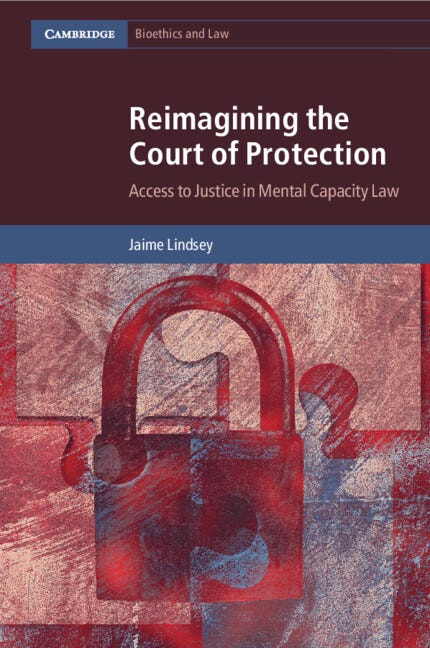
This Substack will return, repeatedly, to the themes of evidence, lawfulness, institutional memory, and the closing of ranks. Because if the state is allowed to act first, justify itself later, and quietly rebuild the missing foundations only after challenge, then what we are dealing with is not simply bad administration.
It is power without proper accountability.
The human cost is measured in years of suffering for children, vulnerable adults and the people who love them and try to protect them.
If you have thoughts on how your own case fits with the themes of evidence, accountability, institutional memory or the closing of ranks, feel free to leave a comment or message me. This series is not only about policy. It is also about how systems behave in practice.
Links to Open Justice Court of Protection articles on Luba’s case
Thank you, Nataly, for writing this with such clarity and integrity.
This is not just one case. It raises serious questions about how evidence is handled, how decisions are made, and why accountability is so difficult to achieve.
Please, good people, read it, and ask yourself how this is allowed to happen?